Potential implications of public agricultural investment on economic outcomes in Tanzania
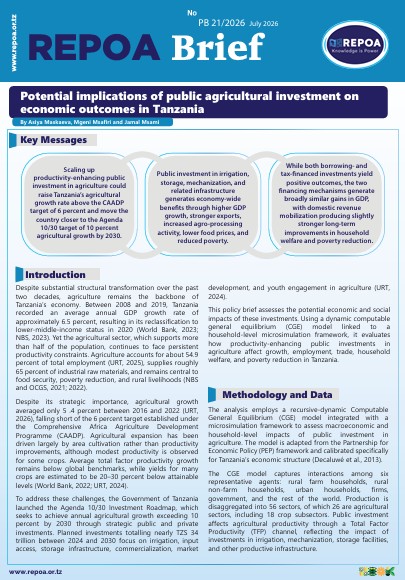
This Policy Brief assesses the potential economic and social impacts of nearly TZS 34 trillion in planned agricultural investments between 2024 and 2030, targeting irrigation, access to inputs, storage infrastructure, commercialisation, market development, and youth engagement in agriculture. READ ON…!
Accelerating Agricultural Transformation for Structural Change in Tanzania
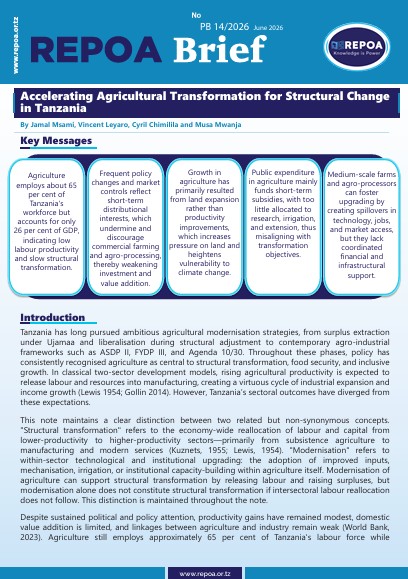
This study examines how political incentives, institutional arrangements, and evolving development ideas have shaped Tanzania’s agricultural modernisation agenda and its contribution to structural transformation. It traces the evolution of agriculture–industry linkages across major political-economic regimes, analysing how shifts from state-led strategies to market-oriented and agro-industrial approaches have influenced policy priorities and implementation outcomes. In doing […]
Accelerating Industrial Transformation for Structural Change in Tanzania
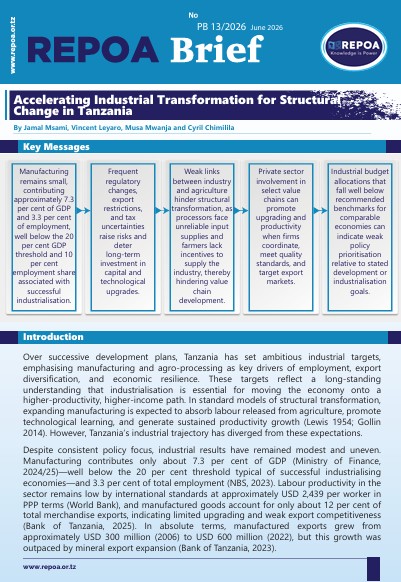
This policy note examines how political incentives, institutional frameworks, and economic systems have shaped Tanzania’s industrial transformation. The analysis is structured around four political-economy dimensions—interests, incentives, power relations, and ideational frameworks—which together explain why repeated industrial strategies have had limited success in upgrading and creating employment.READ ON…!
Maritime Security as a Foundation for Tanzania’s Blue Economy and National Resilience
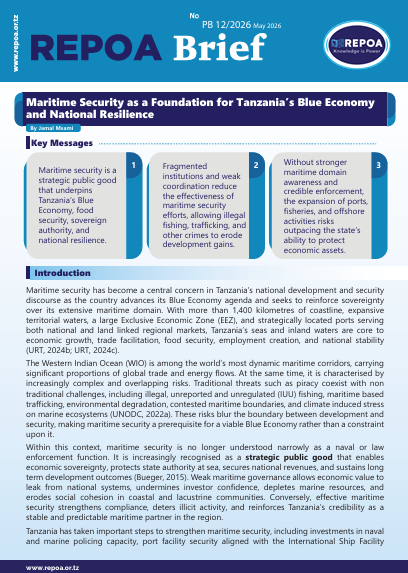
Tanzania has taken important steps to strengthen maritime security, including investments in naval and marine policing capacity, port facility security aligned with the International Ship Facility Security (ISPS) Code, participation in regional cooperation mechanisms, ratification of relevant international instruments, and the establishment of the National Joint Operations Centre (NJOC) as a platform for inter agency […]
Trade Facilitation and Logistics as Pillars of Tanzania’s Blue Economy Competitiveness
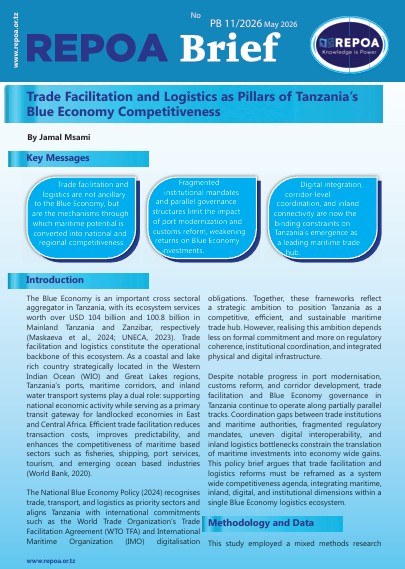
This Policy Brief calls for trade facilitation and logistics reforms to be repositioned as a system wide competitiveness agenda. It advocates for an integrated Blue Economy logistics ecosystem that aligns maritime, inland transport, digital infrastructure, and institutional reforms to strengthen trade efficiency, economic resilience, and sustainable growth. READ ON…!
Financing the Blue Economy for Tanzania’s Marine and Inland Water Transformation
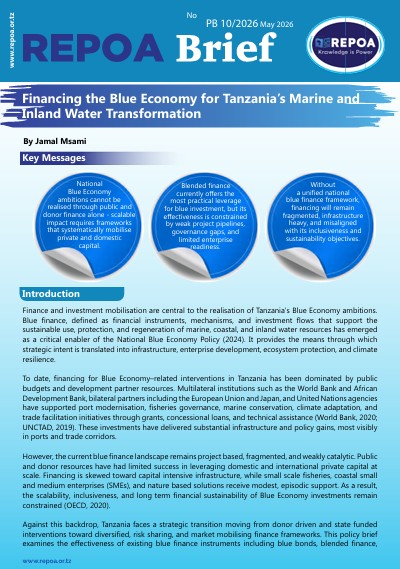
This Policy Brief examines the effectiveness of existing blue finance instruments including blue bonds, blended finance, and risk mitigation mechanisms, assesses systemic constraints, and outlines policy directions to strengthen alignment between finance, development priorities, and international good practice. READ ON…!
Social and Environmental Safeguards as Foundations for an Inclusive and Resilient Blue Economy in Tanzania
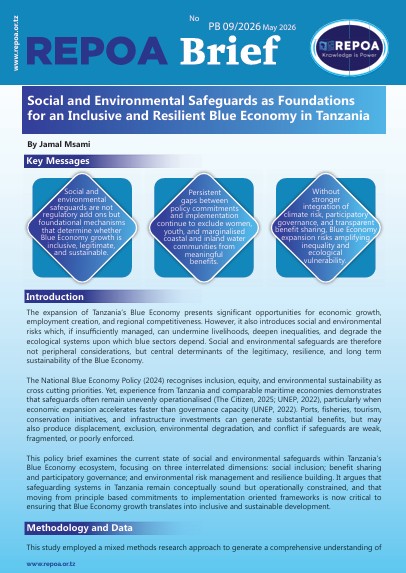
This Policy Brief examines the current state of social and environmental safeguards within Tanzania’s Blue Economy ecosystem, focusing on three interrelated dimensions: social inclusion; benefit sharing and participatory governance; and environmental risk management and resilience building. It argues that safeguarding systems in Tanzania remain conceptually sound but operationally constrained, and that moving from principle based […]
Capacity Building and Human Capital Development for Tanzania’s Blue Economy Transformation
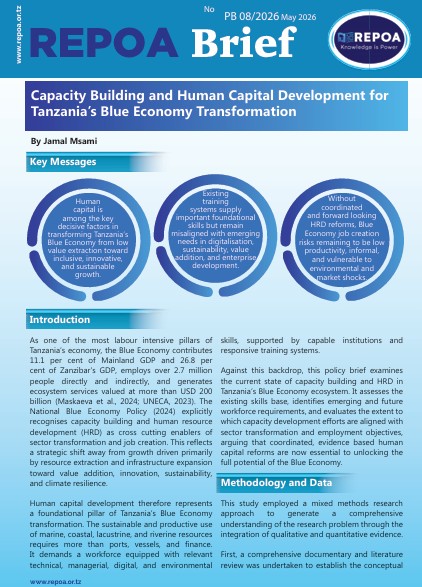
This Policy Brief examines the current state of capacity building and and Human Resource Development (HRD) in Tanzania’s Blue Economy ecosystem. It assesses the existing skills base, identifies emerging and future workforce requirements, and evaluates the extent to which capacity development efforts are aligned with sector transformation and employment objectives, arguing that coordinated, evidence based […]
Policy Innovations for Improved Agricultural Production in Tanzania
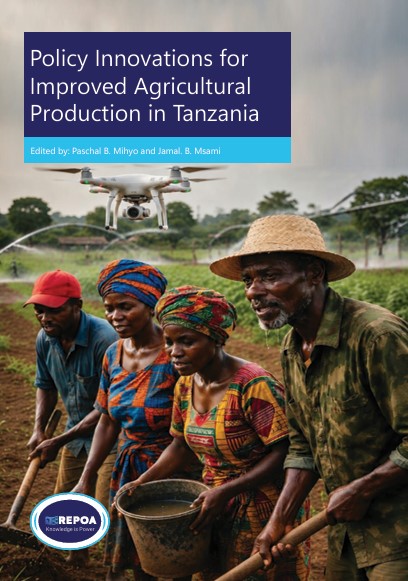
This book emerges as a timely and significant contribution to the national and regional discourse on agricultural development. This volume brings together a diverse range of perspectives, grounded in empirical research and informed by practical experience, to explore how policy innovations can unlock the latent potential of Tanzania’s agricultural sector. The book does not merely […]
Tax policies and informality in Tanzania
This study examines the relationship between tax policies and informality in Tanzania. Specifically, it analyses how changes in tax policies affect the behaviour of individuals in the labour market and how these changes impact the level of inequality and poverty in Tanzania. Tanzania’s informal economy, accounting for over 60% of employment and nearly 40% of […]
Addressing Disparities in Local Economic Development Implementation across Councils in Tanzania
This policy brief explores these disparities and provides actionable recommendations to harmonize Local Economic Development (LED) implementation across councils. This policy brief aims to shed light on the underlying factors contributing to the disparities in LED implementation between urban and rural councils in Tanzania. By examining the specific challenges faced by rural councils, such as […]
Strengthening Local and Regional Strategies for Economic Transformation in Tanzania
This policy brief explores the potential of Local Economic Development (LED) strategies to drive Tanzania’s economic transformation, examining their implementation at both local and regional levels. It analyses the key factors influencing the success of these initiatives, including policy frameworks, resource allocation, and stakeholder engagement. Furthermore, the brief investigates innovative approaches and best practices that […]
Examining Funding Systems for Local Economic Development in Tanzania: A Key Component of Economic Structural Transformation

This study investigates the funding mechanisms that support Local Economic Development (LED) initiatives across seven regions in Tanzania: Kilimanjaro, Dar es Salaam, Mwanza, Kigoma, Iringa, Dodoma, and Mtwara. LED is recognized as a strategic approach to enhancing local economic capacities through decentralized governance, enabling local authorities to tailor initiatives to their communities’ specific needs. However, […]
Strengthening Transparency and Accountability in the Decentralized Funding Systems to enhance Local Economic Development Contributions in Tanzania
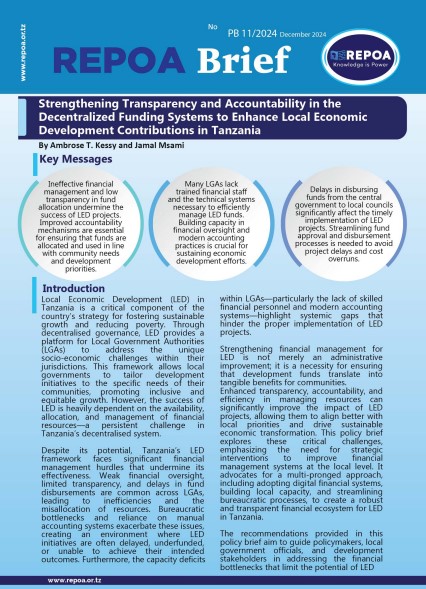
The success of Local Economic Development (LED) in Tanzania is closely linked to the effectiveness of financial management systems at the local level. Improving transparency, building financial management capacity, and decentralising fund disbursement are critical for ensuring that LED initiatives are sustainable and aligned with community development needs. By addressing these challenges, Tanzania can enhance […]
Diversifying Funding Sources for Sustainable Local Economic Development: Leveraging Public-Private Partnerships and Community
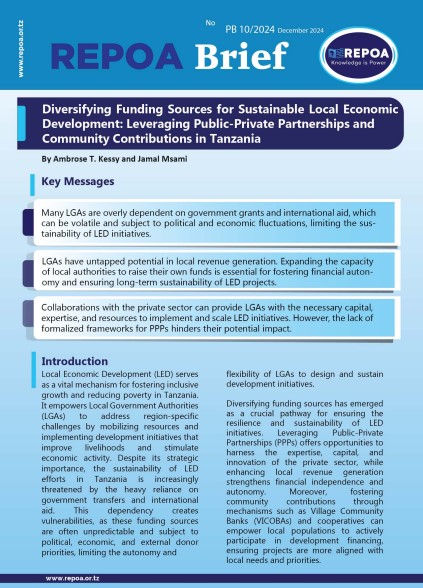
Diversifying funding sources for LED initiatives is essential for building more sustainable and resilient local economies in Tanzania. Overreliance on central government transfers and international aid leaves many LGAs vulnerable to funding delays and budget cuts. By expanding public-private partnerships, enhancing local revenue generation, and promoting community-driven contributions, LGAs can secure more stable and sustainable […]
The Manufacturing Sector in Zanzibar: The Case Study of the Capacity Utilization, Manufacturing Costs, Business Environment, Investment Incentives, and Skills Gaps
The Revolutionary Government of Zanzibar (RGoZ) is determined to spur industrialization as among the means to meet the Zanzibar Vision 2025 of attaining the “upper middle-income status by the year 2050 through sustainable and inclusive human development1 ” This study aims at supporting such efforts by building a knowledge base and inform policy reforms in […]