Dynamics of Service Sector in Tanzania and its role in structural transformation
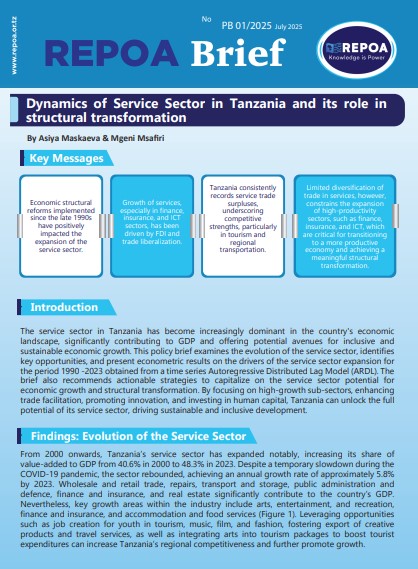
The service sector in Tanzania has become increasingly dominant in the country’s economic landscape, significantly contributing to GDP and offering potential avenues for inclusive and sustainable economic growth. This policy brief examines the evolution of the service sector, identifies key opportunities, and present econometric results on the drivers of the service sector expansion for the […]
Building productive capacities in Tanzania—opportunities and constraints in the coffee sub-sector
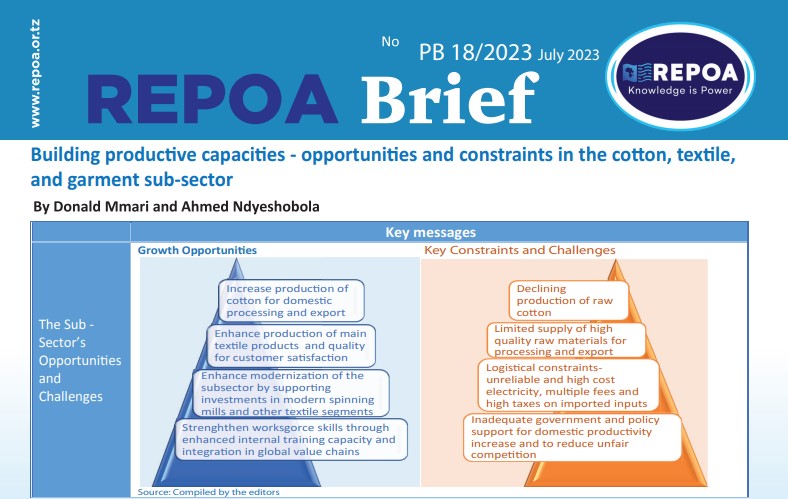
It is recommended that this framework of analysis is adapted to inform policy analysts, private sector practitioners, and decision makers in public institutions responsible for promoting economic growth; agriculture and cooperative development; investments, trade, and industrial development; private sector development, and providing the requisite political champion for the coffee sub-sector. It is the ability these […]
Trust in tax administration: Why it matters for tax compliance
Trust is a foundational component of any tax system, particularly in environments where enforcement capacity is weak. In Tanzania, businesspeople exhibit low levels of trust in tax authorities, undermining voluntary compliance and weakening the legitimacy of the tax system. However, trust is not static; it can be built – and rebuilt – through better services, […]
To trust or not to trust? Taxation from the perspective of businesspeople in Tanzania

Given the limited capacity for effective tax enforcement and monitoring in developing countries, taxpayers’ trust in the tax system is essential for fostering voluntary tax compliance. Since businesses account for a substantial portion of tax revenues, this paper examines the factors that predict trust in the tax authority, drawing on a large-scale survey of businesspeople’s […]
REPOA’s Annual Report 2024
Dear Esteemed Stakeholders, we are pleased to present to you our Annual Report for 2024, which offers a comprehensive account of the performance and results achieved during the final year of implementation of REPOA’s Strategic Plan 2020-2024. This report reflects our continued commitment to undertaking impactful research, strengthening capacity for research and evidence use, and […]
Urban Motorcycle Taxi -related crimes in Dar es Salaam and Pwani Regions, Tanzania
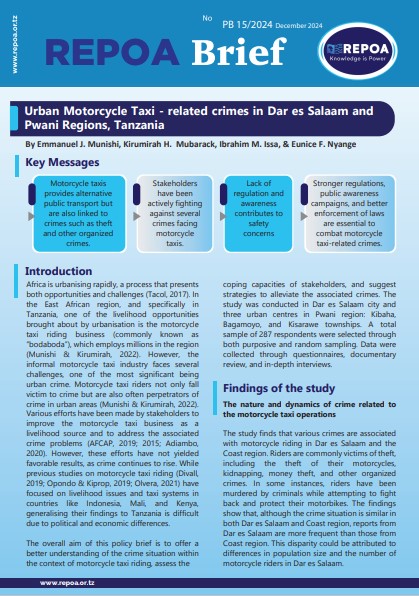
The overall aim of this policy brief is to offer a better understanding of the crime situation within the context of motorcycle taxi riding, assess the coping capacities of stakeholders, and suggest strategies to alleviate the associated crimes. The study was conducted in Dar es Salaam city and three urban centres in Pwani region: Kibaha, […]
Addressing Disparities in Local Economic Development Implementation across Councils in Tanzania
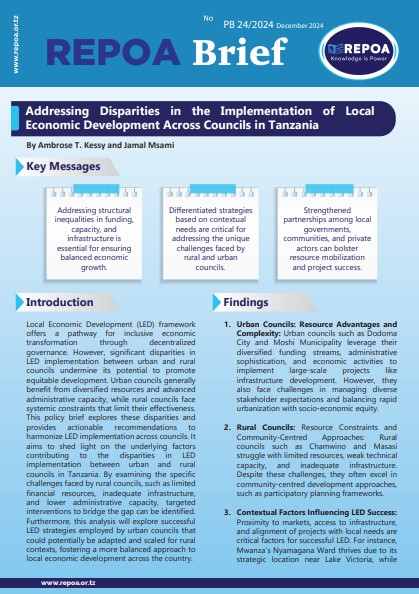
This policy brief explores these disparities and provides actionable recommendations to harmonize Local Economic Development (LED) implementation across councils. This policy brief aims to shed light on the underlying factors contributing to the disparities in LED implementation between urban and rural councils in Tanzania. By examining the specific challenges faced by rural councils, such as […]
Strengthening Local and Regional Strategies for Economic Transformation in Tanzania
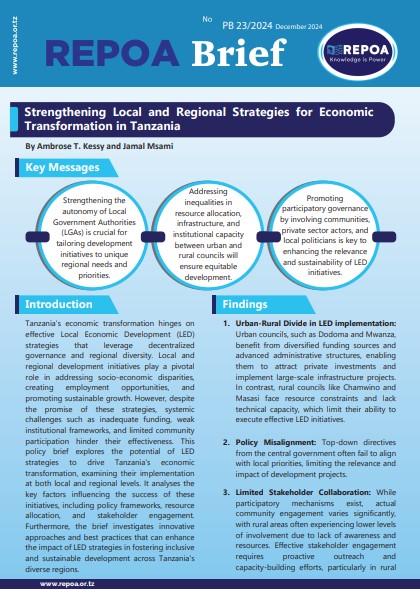
This policy brief explores the potential of Local Economic Development (LED) strategies to drive Tanzania’s economic transformation, examining their implementation at both local and regional levels. It analyses the key factors influencing the success of these initiatives, including policy frameworks, resource allocation, and stakeholder engagement. Furthermore, the brief investigates innovative approaches and best practices that […]
Enhancing smallholder tomato farmers’ adaptive capacity through access to and uptake of climate change information in Tanzania

This policy brief investigates factors that influence access to and uptake of climate change information by smallholder tomato growers, and the key strategies for improving access to and uptake of climate change information by smallholder tomato growers. READ ON…!
Urban solid waste management and the decent work: Insights from Tanzania’s key cities
This study investigates the labour practices of employed and freelance solid waste workers in Tanzania’s major cities namely Dar es Salaam, Mwanza, and Dodoma through the lens of the International Labour Organization’s (ILO) decent work framework. Focusing on key areas such as job and income security, fair wages, occupational health and safety, child protection and […]
Unlocking Tanzania’s potential: Youth look to jobs, entrepreneurial opportunities
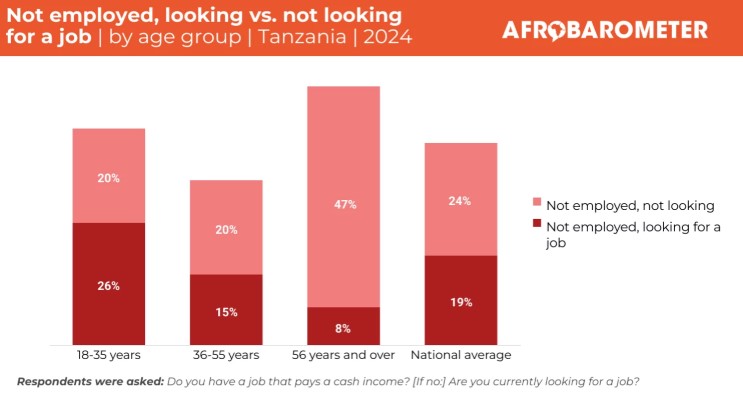
On their top priorities for government action – including health, water supply, infrastructure/roads, electricity, education, and job creation – young citizens give the government positive performance reviews, and a majority see the country as moving in “the right direction.” But their assessments of economic and living conditions are less positive, and economic opportunity tops of […]
Tanzanians applaud government performance on health, but it remains their top concern
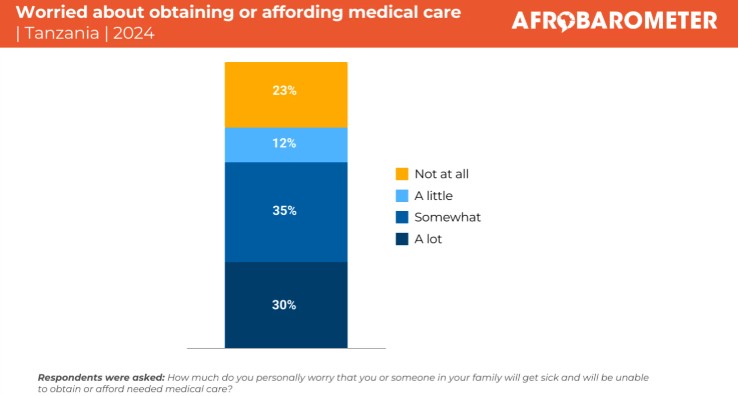
This dispatch/ policy brief presents findings from a special Afrobarometer Round 10 survey module focusing on health care. READ ON by clicking the Download.PDF button…!
Why property tax reforms fail: Lessons from Tanzania
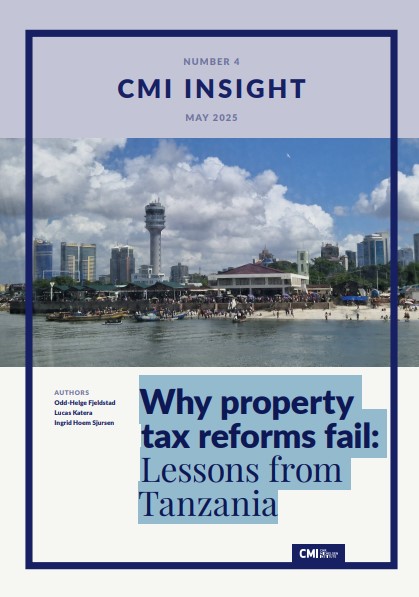
Over the past two decades, property tax administration in Tanzania has undergone substantial changes, shifting between decentralized and centralized collection models. However, despite numerous reform initiatives, these efforts have largely failed to boost tax revenues and improve property tax administration. This CMI (in collaboration with REPOA) Insight outlines five reasons why these reforms have not […]
Taxation and Business Development in Zanzibar: Insights from a Business Survey

The private sector is a critical driver of economic growth in Tanzania. The government has expressed a strong commitment to fostering a vibrant business environment while ensuring sufficient public resources for economic development. However, balancing taxation and business growth remains a challenge. This report presents findings from a survey of businesspeople in Zanzibar, examining their […]
Enhancing Food Security among Smallholders through Climate-Smart Agriculture in Tanzanian Arid Regions

Climate-smart agriculture (CSA) has been proposed as an approach to mitigate some of the threats emanating from climatic changes and guide agriculture management in the era of climate change. This study aimed to (a) assess the CSA practices and technologies and their impacts on household food security among smallholders in Tanzania’s arid and semi-arid agroecological […]
Assessing Small – Scale Fisher’s Use of Traditional Knowledge for Climate Adaptation in Southern Coastal Areas

The study aimed to assess small-scale fishers’ use of traditional knowledge for climate adaptation in Lindi and Mtwara regions located in the Southern Coastal areas of Tanzania. The study used a qualitative research approach wherein in-depth interviews, focus group discussions and observation were used to collect data. Climate change affects fishing activities since rainfall is […]