Strengthening Local Government Capacity and Autonomy for Food and Nutrition in Kagera Region
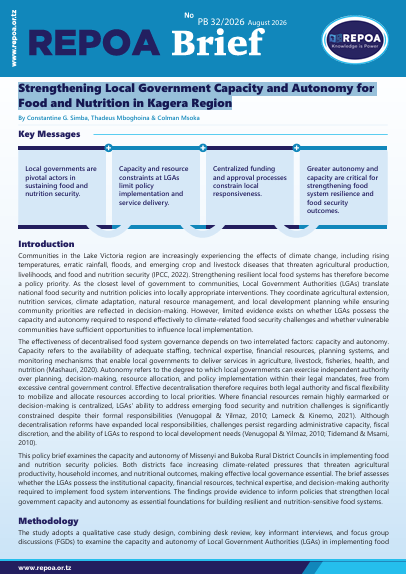
This policy brief examines the capacity and autonomy of Missenyi and Bukoba Rural District Councils in implementing food and nutrition security policies. Both districts face increasing climate-related pressures that threaten agricultural productivity, household incomes, and nutritional outcomes, making effective local governance essential. The brief assesses whether the LGAs possess the institutional capacity, financial resources, technical […]
Business Environment Reforms and Structural Transformation in Tanzania
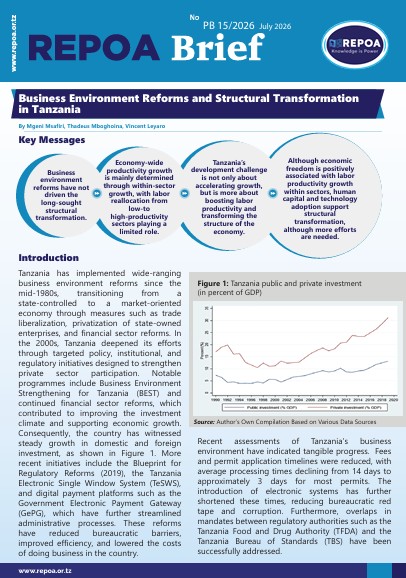
This Policy Brief presents an assessment of whether Tanzania’s business environment reforms over the past three decades have translated into productivity-enhancing structural transformation of the economy. Utilizing shift-share decomposition and econometric analysis for the 1990–2018 period, this brief presents stylized facts about structural transformation in Tanzania and analyses the impact of reforms on productivity growth […]
Assessing the adequacy of graduate skills in the context of council loans for the youth in Tanzania
This Policy Brief examines youth skills in Tanzania and assesses how the 4% Local Government Authorities (LGAs) youth loan scheme helps bridge critical skills gaps, providing evidence to inform more effective youth empowerment policies and programmes. READ ON…!
Experience of youth in applying for the Councils Economic Empowerment loans
This Policy Brief explores the experiences of young people in Tanzania in accessing youth loans provided by local government councils. Drawing on their firsthand experiences, it highlights key challenges and opportunities within the application process, offering evidence-based insights and practical recommendations to help policymakers and other stakeholders strengthen the effectiveness, accessibility, and impact of council-administered […]
Challenges faced by youth beneficiaries of loans from the Local Government Authorities
This Policy Brief delineates the business challenges facing youth in Tanzania who have received capital through the Local Government Authorities (LGAs) credit scheme to inform its implementation. READ ON…!
From land expansion to efficiency: Tanzania’s hope for sustainable rice production
Over the years, Tanzania has witnessed significant expansion in domestic rice production, making it the second most important food crop in the country. This Policy Brief proposes a number of policy measures to improve rice yields in Tanzania – to catch up with the global and regional production averages. READ ON…!
Post-Harvest Losses in Marketed fruits and vegetables: Evidence from selected markets in Dar es Salaam
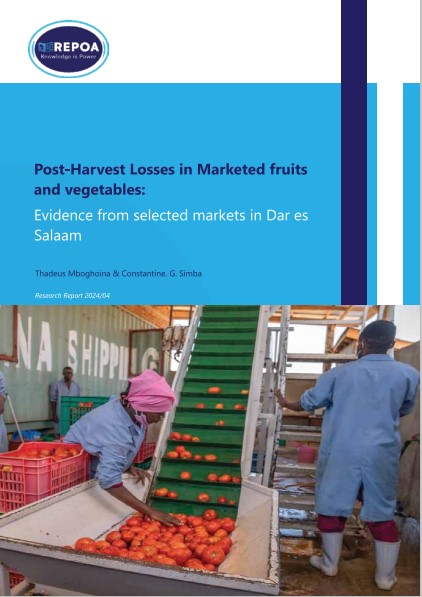
This study attempts to bridge the existing knowledge gap by focusing on post-harvest losses (PHL) in marketed fruits and vegetables in Dar es Salaam. There is arguably a limited but growing body of literature dedicated to studying PHLs in fruits and vegetables. There is even lesser attention, especially in developing economies, paid to losses incurred […]
Tanzanians commend COVID-19 response but call for more investment in preparing for future health emergencies
A recent Afrobarometer survey reveals that about one in seven Tanzanian households report losing a primary source of income due to the pandemic. Only about three in 10 adults say they have been vaccinated against COVID-19, and willingness to get vaccinated is strongly associated with trust in the government to ensure vaccine safety. Tanzanians are […]
Tourism in Tanzania: status, trend, and existing growth potentials
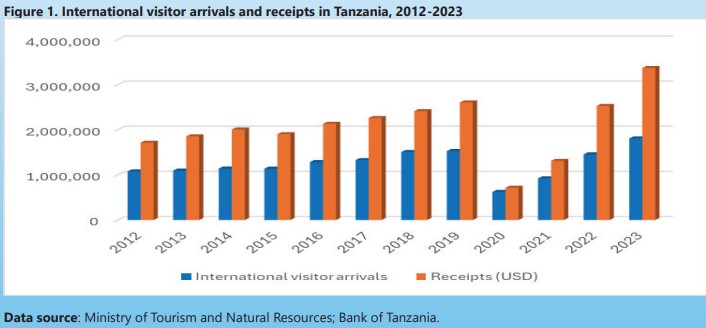
Tourism plays a significant role in livelihoods & poverty reduction, directly employing over 1.4 million workers and contributing 17% to GDP. Notwithstanding a near 75% decline following the global outbreak of the COVID-19 pandemic, receipts from international arrivals doubled between 2012 and 2023. Synergies between tourism and other sectors can be leveraged to facilitate much […]
Public Expenditure Review of Education Sector in Tanzania (Primary and Secondary)

Various studies have confirmed that the provision of quality education depends very much on, among other factors, the amount of budget allocated for education. Thus, the government of Tanzania has committed itself to investing in education by increasing public spending on the education sector with basic education (pre-primary, primary and secondary) receiving the highest proportion […]
Post-harvest losses in marketed fruits and vegetables: evidence from selected markets in Dar es Salaam

A large portion of food loss, especially in Africa, occurs at production or during storage and handling stages (Ridolfi, Hoffmann, & and Baral, 2018). Distribution and marketing processes contribute a further 13% of overall food loss and waste (ibid). Post-harvest fruits and vegetable losses experienced during distribution and marketing is still an area which is […]
Factors Influencing Women’s Ability to Control their Income: The Case of Tanzania
There are conflicting research findings on women’s empowerment because of different methods and populations. Some scholars discovered that over time women’s income control has increased, while others have not found any increase. To shed more light on the phenomenon, this research examines the extent and predictors of women’s independence on making spending decisions whilst living […]
Women’s Empowerment in Tanzania: Predictors of Women’s Ability to Control their Income
This policy brief explores on women’s empowerment in Tanzania: Predictors of women’s ability to control their income. The brief has it that a few women (12%) decided on how to spend their money independently, and that a large proportion of women (88%) made joint spending decisions with their spouses. It finds out that women with […]
The performance of the manufacturing sector in Tanzania Challenges and the way forward
Challenges and the way forward Tanzania’s industrial sector has evolved through various stages since independence in 1961, from nascent and undiversified to state-led import substitution industrialization, and subsequently to de-industrialization under the structural adjustment programmes and policy reforms. The current development agenda, however, has brought industrial development back to be one of the policy priorities.
Social Protection of the Elderly in Tanzania: Current Status and Future Possibilities
This brief summarises the findings of a study on social protection of elderly in Tanzania. The study began by analysing the current status of living arrangements and material well-being of Tanzanians over 60 years of age, using data from the 2007 Household Budget Survey (HBS 2007) conducted by the National Bureau of Statistics and the […]
Social Protection of the Elderly in Tanzania
Current Status and Future Possibilities This study begins by analyzing the current status of living arrangements and material well-being of Tanzanians over 60 years of age, using data from the 2007 Household Budget Survey conducted by the National Bureau of Statistics and the Views of the People