Assessing the adequacy of graduate skills in the context of council loans for the youth in Tanzania
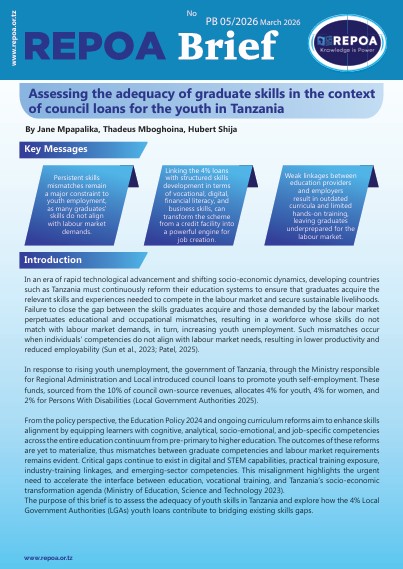
This Policy Brief examines youth skills in Tanzania and assesses how the 4% Local Government Authorities (LGAs) youth loan scheme helps bridge critical skills gaps, providing evidence to inform more effective youth empowerment policies and programmes. READ ON…!
Experience of youth in applying for the Councils Economic Empowerment loans
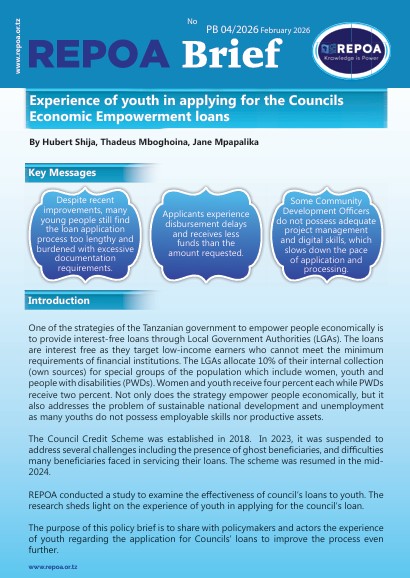
This Policy Brief explores the experiences of young people in Tanzania in accessing youth loans provided by local government councils. Drawing on their firsthand experiences, it highlights key challenges and opportunities within the application process, offering evidence-based insights and practical recommendations to help policymakers and other stakeholders strengthen the effectiveness, accessibility, and impact of council-administered […]
Challenges faced by youth beneficiaries of loans from the Local Government Authorities
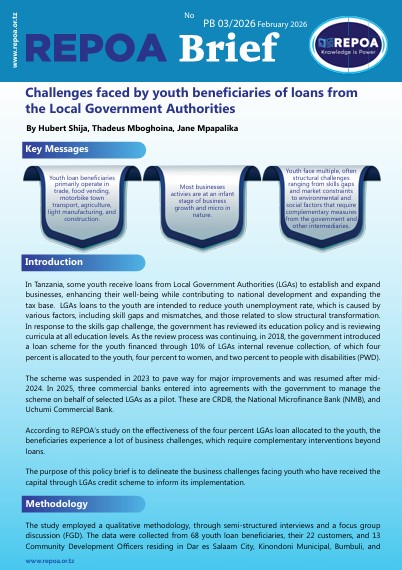
This Policy Brief delineates the business challenges facing youth in Tanzania who have received capital through the Local Government Authorities (LGAs) credit scheme to inform its implementation. READ ON…!
Citizen Engagement in Tanzania: Awareness and Access to Government Information
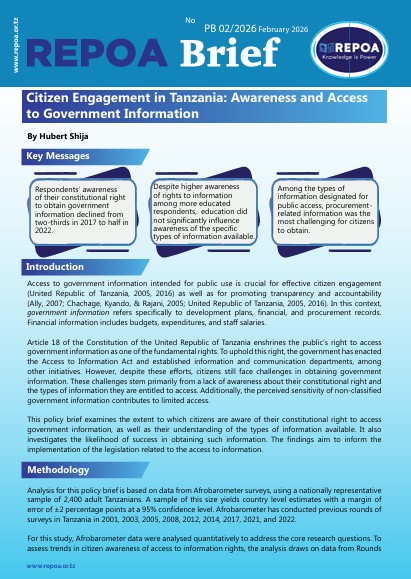
This policy brief examines the extent to which citizens are aware of their constitutional right to access government information, as well as their understanding of the types of information available. It also investigates the likelihood of success in obtaining such information. The findings aim to inform the implementation of the legislation related to the access […]
Cleaner cooking solutions: Optimizing biomass briquettes to replace charcoal and mitigate climate change in Tanzania
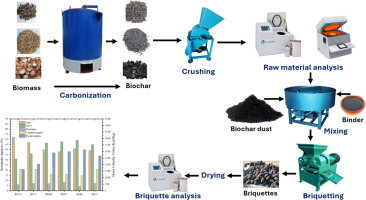
In Tanzania, overreliance on charcoal and firewood for domestic energy has intensified deforestation and environmental degradation, creating an urgent need for sustainable biomass-based fuels. This study investigates the optimization of biomass briquettes produced from locally available agricultural residues (coconut shell, palm kernel shell, rice husk) and forest wastes as sustainable alternatives to charcoal. Click on […]
Gender equality and women’s empowerment: The unintended consequence of women’s access to the labour market
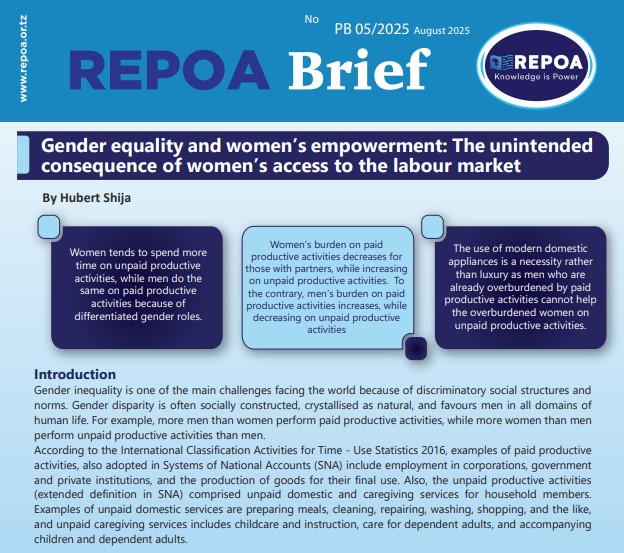
This Policy Brief compares the relative workloads of women and men based on a workload limit of 10:30 hours a day according to the Women’s Empowerment in Agriculture Index (WEAI) to inform the gender related policies. Read ON…!
Tanzanians applaud government performance on health, but it remains their top concern
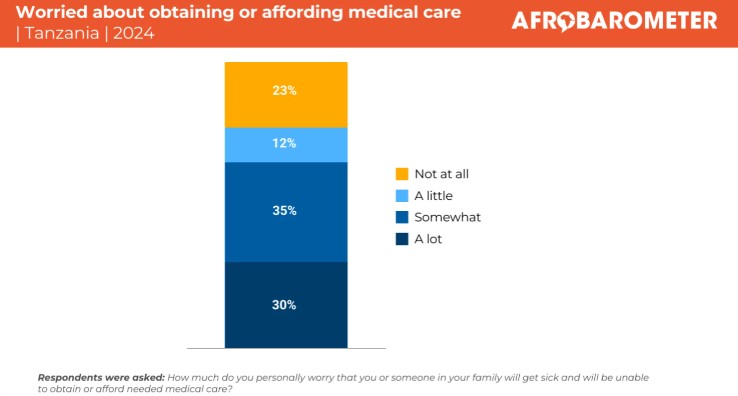
This dispatch/ policy brief presents findings from a special Afrobarometer Round 10 survey module focusing on health care. READ ON by clicking the Download.PDF button…!
Climate change mitigation and adaptation: Profile of biomass briquette producers in Tanzania
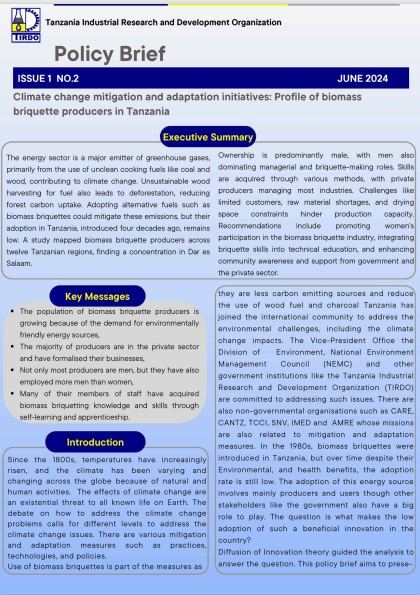
Many producers operate in the private formal sector. Despite being formalised, their staffing does not reflect the initiative to address gender inequality because the majority of staff are men. Majority of the staff members did not acquire biomass briquetting knowledge and skills through formal training: they did it through self-learning and apprenticeship. READ MORE by […]
Climate Change Adaptation and Mitigation: Factors influencing the adoption of biomass briquettes in Tanzania
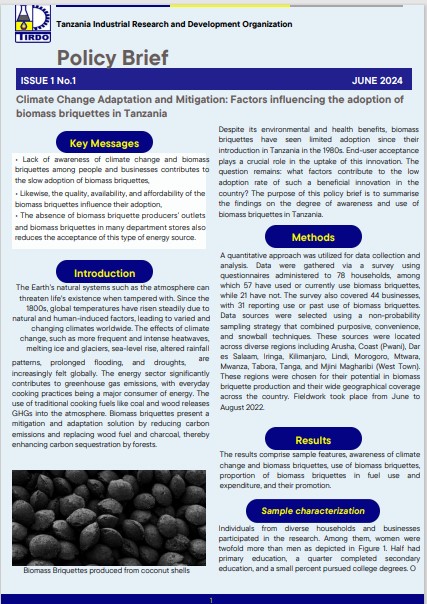
The biomass briquette adoption is not as high as expected despite their benefits because of the lack of climate change and biomass briquette awareness. Additionally, their quality, affordability, and availability vary, and can mainly be sourced from producers selling such products due to lack of distribution models. However, because of the design of this research, […]
Factors influencing Online Citizen Engagement at the Local Level in Tanzania
The adoption of e-participation adoption is found to be conditioned by the Information and Communication Technology (ICT) environment, government norms, ICT literacy and cost, and awareness among citizens and LLG leaders. The research implies that DOI power will increase when innovation testing is also included in the redesigning/ restructuring stage of the organisation’s innovation-decision process. […]
Democratisation in Tanzania: Re-examining citizens’ preferences for political party systems after 1992

The findings suggest an evolution of popular views on multipartism over time in contrast to reservations expressed to Justice Nyalali’s Commission in 1991. It is possible that, over time, many citizens have grown to prefer pluralism to a single party system because the speculated violence and societal division have not occurred. Also, they trust both […]
Re-examining the Citizens’ Preferences for the Political Party Systems in Tanzania after 1992

After the re-adoption of multipartyism in Tanzania in 1992, the preference of many adult Tanzanians for the political party system changed from a single-party system to pluralism. However, in 2005, the number of citizens who preferred a single-party system surpassed the number of those who favoured multipartyism. This could have been influenced by the heightened […]
The language of instruction debate in Tanzania: What is the choice of citizens amongst the international languages?
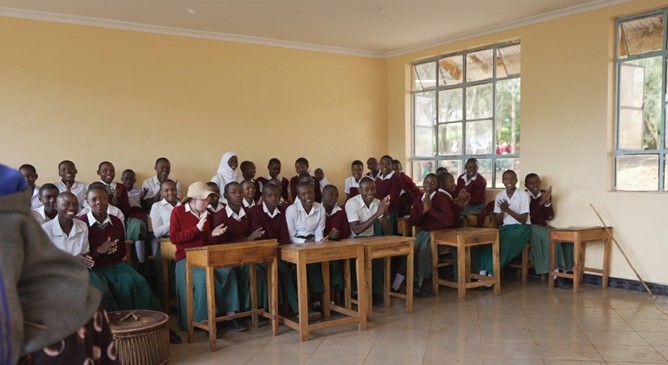
After seven years of the implementation of the 2014 education and training policy, this policy brief explores the choice of citizens of the medium of instruction amongst the international languages. The international languages are Arabic, Chinese, English, French, German, Kiswahili, and Portuguese. The findings will inform the debate on language of instruction in Tanzania, implementation […]
Factors Influencing Women’s Ability to Control their Income: The Case of Tanzania
There are conflicting research findings on women’s empowerment because of different methods and populations. Some scholars discovered that over time women’s income control has increased, while others have not found any increase. To shed more light on the phenomenon, this research examines the extent and predictors of women’s independence on making spending decisions whilst living […]
Women’s Empowerment in Tanzania: Predictors of Women’s Ability to Control their Income
This policy brief explores on women’s empowerment in Tanzania: Predictors of women’s ability to control their income. The brief has it that a few women (12%) decided on how to spend their money independently, and that a large proportion of women (88%) made joint spending decisions with their spouses. It finds out that women with […]